Hardness shore a polymer compound type coefficient of friction.
Epdm rubber coefficient of friction.
The coefficient of static friction typically denoted as μ s is usually higher than the coefficient of kinetic friction.
The resistance to polar substances and steam are also good.
For example static friction can prevent an object from sliding down a sloped surface.
μ static μ s or kinetic μ k frictional coefficient.
Studies in the literature suggest that the cof between a dry epdm.
Static friction results from the normal force of two objects in contact acting opposite the intended motion of one surface against the other.
The frictional force can be expressed as.
Further aim of this work was to investigate on how the friction and wear properties of the epdm rubbers depend on the configuration of the testing rigs.
Fric tion force normal load and coefficient of friction cof were determined.
F f frictional force n lb.
Static friction is friction between two or more solid objects that are not moving relative to each other.
Rubber epdm was measured in an oscillating rolling ball steel on plate rubber configuration oscillating rbop and simulated by fem.
The maximum force of static friction can be calculated by multiplying the normal force by the coefficient of friction specific to the pair of materials in contact.
Dry rubber dry steel 0 80 0 76 0 95 dry rubber greasy steel 0 80 0 76 0 95.
F f μ n 1.
Dry steel dry steel 0 70 0 57 0 80.
N normal force between the surfaces n lb there are at least two types of friction forces.
The friction force is the force exerted by a surface when an object moves across it or makes an effort to move across it.
It was found that with increasing cb content the specific wear rate was reduced.
A similar tendency was found for the cof in rop tests.
The results of the tests and the simulations were compared with each other and discussed.
The friction coefficient cof of the epdm seal and plate was not experimentally measured and is therefore unknown in this study.
Bowden tabor the friction and lubrication of solids oxford.
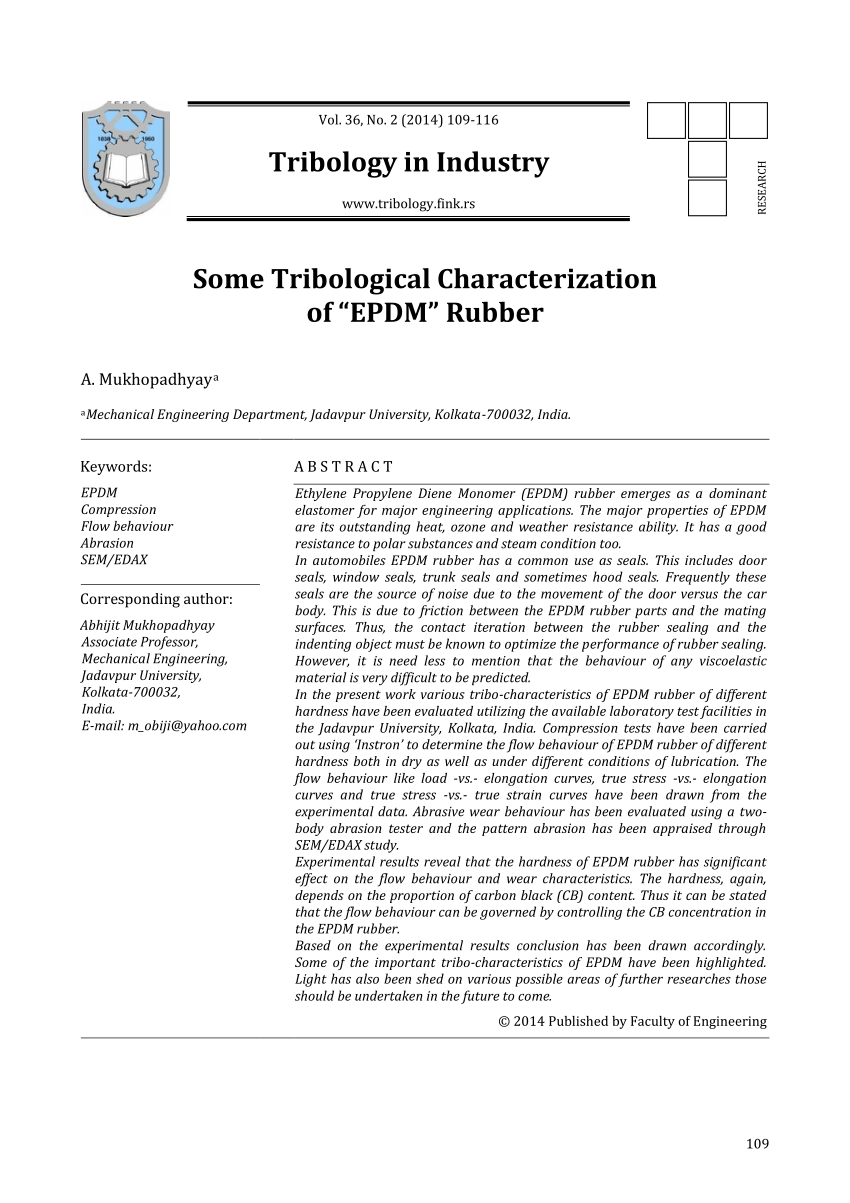
In the present work friction and sliding wear behaviors of indigenously developed ethylene propylene diene monomer rubber epdm of different hardness have been studied against steel counterpart in dry condition.
The rubber stocks were prepared in a laboratory internal mixer and the curatives were introduced on a laboratory open mill.
The coefficient of frictions cof and specific wear rates of the epdms were determined.